ok, we've been through swarms, and self-replicating robots. let's talk
about biomorphic robots at general
@wikipedia
"Biomorphic robotics is a sub-discipline of robotics focused upon
emulating the mechanics, sensor systems, computing structures and
methodologies used by animals. In short, it is building robots
inspired by the principles of biological systems"
But our list is much more interesting and contain newest achievements
which wasn't documented yet in Wikipedia. And this post is more than
just a list, it is an attempt to answer the question what can we learn
from animals about robots, and about them.
Robots imitating animals? Oh, yes, it was always like that. But why?
Please, take some time to watch, we have them all, "all the zoo of
robotics", fishes,dogs,snakes,salamandras, cockroaches,birds..
Why would scientists want to imitate all this farm?
This will not take you a lot of time and one day maybe can even save
your life;). Try to look at robots as they were real animals. Try to
observe they behaviour, but forgot about appearance, they are not
sculptures, they don't have to pretend nothing. How close they seem to
animal world in your opinion?
A FISH, A CARP..
BIG DOG:
This possibly the greatest and most powerfull robot ever. Built by
DARPA, you have probably seen this!
Watch closely how it reacts when kicked. How it behave on ice. What
animal does it look like?
Believe it or not you can find list of robotic dogs.. in Wikipedia!
The famous is japanese robot Aibo.
http://en.wikipedia.org/wiki/List_of_robotic_dogs
SNAKE:
"Why can snakes move ahead on without legs?"
From this problem, we starts every research of snake biomechanisms.
Snake Robots have many possible applications, even though the
structures are simple.
SALAMANDRA:
Salamandra robot? how weird is this?
If you are still with me and reading you've come to the greates part.
There is a chance you can understand WHAT IS THIS ROBOT REALLY ABOUT.
This is work of team from "Lossana Polytechnique". Their work
demonstrates that spinal cords of salamandras contains rather
sophisticated neural circuits that can control complex movements while
receiving only HIGH-LEVEL command signals. And here we come to a
moment when biomorphism in robotics helps us understanding
biology,evolution.. maybe even more! If you are a
programmer/administrator you probably know what "high-level command"
means. It means abstraction. When you finally realize that what
differs us from salamandras is just few levels of abstraction.. That
is where robotics is becoming very scary.
COCKROACH:
Yes, cockroaches. If you're courious to see robot climbing up the
wall, watch this one:
BIRD:
Flying mechanism similar to that we can observe on animals, is very
sophisticated, and hard to imitate. There are some breakthroughs
lately, I found a movie of a very slow flying robot. Amazing.
So you thought robots can imitate only animals?
A FLOWER:
http://en.wikipedia.org/wiki/Flower_robot
What else robot could imitate? Do you feel threatened by robots?
After this post I would like you to know what biomorphic robotics
mean, and what it means to you;p
http://birg.epfl.ch/page65446.html
http://en.wikipedia.org/wiki/Flower_robot
http://en.wikipedia.org/wiki/Biomorphic_robotics
Saturday, 12 June 2010

Thursday, 10 June 2010
POPULARITY OF WEBAPPS - GOOGLE - PART II
POPULARITY OF WEBAPPS – GOOGLE
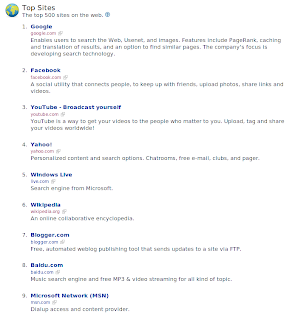
Alexa is the #1 site for checking websites popularity. As we can see Google is an absolute leader. Fallowed by facebook and YouTube.
So what is really behind of success of Google ?
Google named from largest number know by humans GOOGOL(10 to the power 100). Was started as a privately held company on September 4,1998 by two Stanford University students Larry Page and Sergey Brin. Since now Google has been repeatedly named Fortune Magazine's Number One Best Place to Work and most powerful brand in the world.
Alexa lists Google as the Internet's most visited website. It was only 12 Years that Google became one of the most powerful companies in future world of IT.
Maybe not everyone knows, but most of google success came from Google AdWords.
YOUTUBE...
Google AdWords is a flagship advertising product that google intrudoced in 2000 and it was really extension of idea that Bill Gross borrowed from YellowPages. Google AdWords gave company in 2008 a USD$28 Billion revenue.
AdWords offers pay-per-click (PPC) advertising, and site-targeted advertising for both text and banner ads. The AdWords program includes local, national, and international distribution. Google's text advertisements are short, consisting of one title line and two content text lines. Image ads can be one of several different Interactive Advertising Bureau (IAB) standard sizes.
Google dominated the advertising on the internet which was on of the most important decision in company development over they past ten years.
Another success follower from Google was introduced in 2004 as invite-only beta the Google-Mail better known now as Gmail. Now Gmail as of july 2009 has 146 million users and counting. Gmail offered few new and for that time revolutionary services that decided about Gmail success. With an initial 1GB storage Gmail significantly increased the Webmail standard for free storage from the 2 to 4MB its competitors offered at that time. Gmail has a search-oriented interface and a "conversation view" similar to an Internet forum. Software developers know Gmail for its pioneering use of the Ajax programming technique.
Google yet most popular service is Google search engine itself.
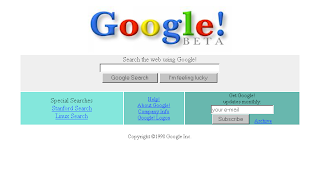
It's still the most used web search engine on the web. Google receives several hundred million queries each day through its various services
Than google started to ship a whole range of products available to public.
With official Gmail google announced Google Apps suit for business users.
Google calendar integrated with gmail. Google docs, and on line office editing capabilities, contacts etc. Google started to work on their smart phone operating system called Android and now even their own operating system based on linux Google Chrome OS which is really the Google Chrome web browser (another product of Google) closed in an OS. Google Picasa and Web Albums are worth to mention also as they have strongly underlined Google multimedia aspirations. As well as the Google Earth and later Google Maps where a revolutionary for their times, and now are used in Townsend of apps and web pages across the world.
In your opinion what was the most interesting Google product you have been using or you'd started using or began with Google ?
Alexa is the #1 site for checking websites popularity. As we can see Google is an absolute leader. Fallowed by facebook and YouTube.

So what is really behind of success of Google ?
Google named from largest number know by humans GOOGOL(10 to the power 100). Was started as a privately held company on September 4,1998 by two Stanford University students Larry Page and Sergey Brin. Since now Google has been repeatedly named Fortune Magazine's Number One Best Place to Work and most powerful brand in the world.
Alexa lists Google as the Internet's most visited website. It was only 12 Years that Google became one of the most powerful companies in future world of IT.
Maybe not everyone knows, but most of google success came from Google AdWords.
YOUTUBE...
Google AdWords is a flagship advertising product that google intrudoced in 2000 and it was really extension of idea that Bill Gross borrowed from YellowPages. Google AdWords gave company in 2008 a USD$28 Billion revenue.
AdWords offers pay-per-click (PPC) advertising, and site-targeted advertising for both text and banner ads. The AdWords program includes local, national, and international distribution. Google's text advertisements are short, consisting of one title line and two content text lines. Image ads can be one of several different Interactive Advertising Bureau (IAB) standard sizes.
Google dominated the advertising on the internet which was on of the most important decision in company development over they past ten years.
Another success follower from Google was introduced in 2004 as invite-only beta the Google-Mail better known now as Gmail. Now Gmail as of july 2009 has 146 million users and counting. Gmail offered few new and for that time revolutionary services that decided about Gmail success. With an initial 1GB storage Gmail significantly increased the Webmail standard for free storage from the 2 to 4MB its competitors offered at that time. Gmail has a search-oriented interface and a "conversation view" similar to an Internet forum. Software developers know Gmail for its pioneering use of the Ajax programming technique.
Google yet most popular service is Google search engine itself.

It's still the most used web search engine on the web. Google receives several hundred million queries each day through its various services
Than google started to ship a whole range of products available to public.
With official Gmail google announced Google Apps suit for business users.
Google calendar integrated with gmail. Google docs, and on line office editing capabilities, contacts etc. Google started to work on their smart phone operating system called Android and now even their own operating system based on linux Google Chrome OS which is really the Google Chrome web browser (another product of Google) closed in an OS. Google Picasa and Web Albums are worth to mention also as they have strongly underlined Google multimedia aspirations. As well as the Google Earth and later Google Maps where a revolutionary for their times, and now are used in Townsend of apps and web pages across the world.
In your opinion what was the most interesting Google product you have been using or you'd started using or began with Google ?
Swarm robots
In this blog entry I would like to show you most exciting things you
can find all over the world in the subject of robotics, things that
will let you show off and shine brightly on some geek party :D Let's
start with swarms.. yes, we are not talking about bees or ants but
robots!
Swarm robotics
A single ant is nothing on it’s own but by working together ants can
build elaborate nests and accomplish feats that are unfathomable by
individuals. This idea of swarm intelligence is being used by
engineers to produce robots that can save lives. These robots, each
equipped with their own sensors and wireless receivers, can
communicate with the rest of the swarm in order to tackle a much
greater task than any one robot could accomplish on it’s own.
Swarm robotics is a new approach to the coordination of multirobot
systems which consist of large numbers of mostly simple physical
robots. It is supposed that a desired collective behavior emerges from
the interactions between the robots and interactions of robots with
the environment. This approach emerged on the field of artificial
swarm intelligence, as well as the biological studies of insects, ants
and other fields in nature, where swarm behaviour occurs.
Do you know what it means to "emerge"? Do you really understand
the power of this term? Do you realize that we are all a product of
"emergence"?
Let's dive more into the subject.
Self assembly robots
Modular self-reconfiguring robotic systems or self-reconfigurable
modular robots are autonomous kinematic machines with variable
morphology. Beyond conventional actuation, sensing and control
typically found in fixed-morphology robots, self-reconfiguring robots
are also able to deliberately change their own shape by rearranging
the connectivity of their parts, in order to adapt to new
circumstances, perform new tasks, or recover from damage.
For example, a robot made of such components could assume a worm-like
shape to move through a narrow pipe, reassemble into something with
spider-like legs to cross uneven terrain, then form a third arbitrary
object (like a ball or wheel that can spin itself) to move quickly
over a fairly flat terrain; it can also be used for making "fixed"
objects, such as walls, shelters, or buildings.
The ISI Polymorphic Robotics Laboratory at USC has a fantastic robot
called the Superbot that is capable of numerous modes of motion and is
made of several autonomous units that can be manually assembled or
sometimes automatically self assembled. Excellent videos below:
Are you interested in building your own self-assembly swarm?;) here is
a handbook !
http://www.instructables.com/id/Autonomous,-Self-Assembling-Robots/
Read more:
http://en.wikipedia.org/wiki/Self-reconfiguring_modular_robot
http://scienceray.com/technology/applied-science/the-nine-most-amazing-robots-ever/#ixzz0pdJ6IUxF
can find all over the world in the subject of robotics, things that
will let you show off and shine brightly on some geek party :D Let's
start with swarms.. yes, we are not talking about bees or ants but
robots!
Swarm robotics
A single ant is nothing on it’s own but by working together ants can
build elaborate nests and accomplish feats that are unfathomable by
individuals. This idea of swarm intelligence is being used by
engineers to produce robots that can save lives. These robots, each
equipped with their own sensors and wireless receivers, can
communicate with the rest of the swarm in order to tackle a much
greater task than any one robot could accomplish on it’s own.
Swarm robotics is a new approach to the coordination of multirobot
systems which consist of large numbers of mostly simple physical
robots. It is supposed that a desired collective behavior emerges from
the interactions between the robots and interactions of robots with
the environment. This approach emerged on the field of artificial
swarm intelligence, as well as the biological studies of insects, ants
and other fields in nature, where swarm behaviour occurs.
Do you know what it means to "emerge"? Do you really understand
the power of this term? Do you realize that we are all a product of
"emergence"?
Let's dive more into the subject.
Self assembly robots
Modular self-reconfiguring robotic systems or self-reconfigurable
modular robots are autonomous kinematic machines with variable
morphology. Beyond conventional actuation, sensing and control
typically found in fixed-morphology robots, self-reconfiguring robots
are also able to deliberately change their own shape by rearranging
the connectivity of their parts, in order to adapt to new
circumstances, perform new tasks, or recover from damage.
For example, a robot made of such components could assume a worm-like
shape to move through a narrow pipe, reassemble into something with
spider-like legs to cross uneven terrain, then form a third arbitrary
object (like a ball or wheel that can spin itself) to move quickly
over a fairly flat terrain; it can also be used for making "fixed"
objects, such as walls, shelters, or buildings.
The ISI Polymorphic Robotics Laboratory at USC has a fantastic robot
called the Superbot that is capable of numerous modes of motion and is
made of several autonomous units that can be manually assembled or
sometimes automatically self assembled. Excellent videos below:
Are you interested in building your own self-assembly swarm?;) here is
a handbook !
http://www.instructables.com/
Read more:
http://en.wikipedia.org/wiki/
http://scienceray.com/
Monday, 7 June 2010
POPULARITY OF WEBAPPS - FACEBOOK - PART I
POPULARITY OF WEBAPPS - FACEBOOK
I'd just seen another entry on one of me tech blogs I'm reading on regular basis saying Facebook grown another 700k users. To just incredible amount of over 350 million users. In the top popularity there where 311K registrations of new Facebook user in Poland every week !!.

THE FIGURES
Company Figures
More than 350 million active users
50% of our active users log on to Facebook in any given day
More than 35 million users update their status each day
More than 55 million status updates posted each day
More than 2.5 billion photos uploaded to the site each month
More than 3.5 billion pieces of content (web links, news stories, blog posts, notes, photo albums, etc.) shared each week
More than 3.5 million events created each month
More than 1.6 million active Pages on Facebook
More than 700,000 local businesses have active Pages on Facebook
Pages have created more than 5.3 billion fans
Average User Figures
Average user has 130 friends on the site
Average user sends 8 friend requests per month
Average user spends more than 55 minutes per day on Facebook
Average user clicks the Like button on 9 pieces of content each month
Average user writes 25 comments on Facebook content each month
Average user becomes a fan of 2 Pages each month
Average user is invited to 3 events per month
Average user is a member of 12 groups
International Growth
More than 70 translations available on the site
About 70% of Facebook users are outside the United States
Over 300,000 users helped translate the site through the translations application
Platform
More than one million developers and entrepreneurs from more than 180 countries
Every month, more than 70% of Facebook users engage with Platform applications
More than 500,000 active applications currently on Facebook Platform
More than 250 applications have more than one million monthly active users
More than 80,000 websites have implemented Facebook Connect since its general availability in December 2008
More than 60 million Facebook users engage with Facebook Connect on external websites every month
Two-thirds of comScore’s U.S. Top 100 websites and half of comScore’s Global Top 100 websites have implemented Facebook Connect
Mobile
There are more than 65 million active users currently accessing Facebook through their mobile devices.
People that use Facebook on their mobile devices are almost 50% more active on Facebook than non-mobile users.
There are more than 180 mobile operators in 60 countries working to deploy and promote Facebook mobile products
Personally I do have an Facebook account, but I'm using it maybe once a month. I started thinking why Facebook is the biggest social network on earth and why in Poland it's the absolute #1 in actively registered users. Let's go through Facebook history and I'll try to answers some questions about the Facebook popularity in our country and over the whole world.
THE BEGINNINGS...
Facebook was started in 2004 for internal use for Harvard University students. After 5 years it has become the most popular place for on-line communities. It received many fundings, from really big companies. Soon it was released to public. Below is a very interesting history of Facebook and why it became the top visited place on the Internet. Some cool facts about Facebook.
Few important figures, investments. I highly recommend you to watch the video.
YOUTUBE VIDEO...
FIRST CONCLUSIONS
Facebook resides somewhere at the crossroads of the consumption model of the Web and the community model. Scrolling through the variety of people, pictures, stories and connections within Facebook, the user is presented with a host of identities and communities in which one may participate. As a consumption model, Facebook offers information and news that is searchable and retrievable. Participants represent themselves or the idea of themselves online for others to desire, emulate, ignore, discard or drink in. Users are able to freely view, click and pick their way through “the goods.”
Unlike many consumption-modeled websites, Facebook allows participants to talk to one another, to sense and see other presences, thus serving as an authentic community. Facebook allows relationships to spawn among groups of individuals where they can interact, crisscross and reinforce one another.
THE Facebook STRENGHTS.
Clean Layout
One of the major strengths of the new look facebook is the clean layout and the simplifying of the profile page so that when you click on a friends profile you immediately have access to their wall/news feed and can quickly see what they have been up to recently and send them a message directly.
Tabbed Browsing
The Profile has been divided up into tabs so that all your personal information is in one place and all your applications are on one tab now called boxes. For many people this has been of huge benefit. You now don't have to wait for ages for a profile to load if a friend has installed 200 applications. Overall the platform seems to be running a lot faster than it did before. Although the tabbed feature is only limited to the profile and doesn't yet extend to other areas where it is desperately needed.
Integration of Wall and Minifeed
Facebook have integrated the wall and the minifeed into one aggregated feed that takes up 70% of the space on your profile page. This major prominence is because facebook has always been designed to focus on creating and maintaining real relationships and building a sense of community. Quickly being able to know what all your friends are doing plays an important role. It has a number of settings and wall filters so you can see only posts made by yourself, others or you can see the stories that facebook has selected for you. You can edit your privacy setting to make sure you only display what you really want to the world.
Makes Sharing Even Easier
Facebook has made the sharing of videos and photos even easier with one dedicated tab and a host of new features to play around with. For more information you can check out a recent blog post facebook the unofficial guide. This clearly shows that facebook can see the future and want photo sharing, video chats and video postcards to be on their system and not on other external services like flickr, ooVoo or Skype.
New Features
Facebook have brought in a lot of new features that help to make facebook the pivotal part of your daily life. They have introduced a new blog subscription service where you can join your favourite blog and enjoy all its content without ever having to leave facebook.
Another nice feature is the ability to create a profile badge that you can place on your website or blog that can show your current status and act like a business card and pull people from outside of facebook to become your friends. To access this feature you can find a link on the bottom left of your profile page.
This still had a few bugs in when I last tested it but I am sure Facebook will iron those out pretty soon. I would also like to be able to customise what is displayed a bit more.
Facebook Notes
The Notes feature has increased in prominence, which is great because it gets more people involved in conversations. Anyone who has a blog can import their posts automatically and then tag their friends to come and make a comment. This runs straight into the wall feed and you can make comments directly on your wall/minifeed and keep updated on the topic without having to go back to the post and scroll down to the bottom each time a new person makes a comment.
I would like to hear your positive comments about the future of facebook, and similar websites, and why do you think they became so popular.
Sunday, 30 May 2010
Phobias - What are you afraid of?
Do you remember moments in your childhood when you were afraid of some things? For instance, you were scared to sleep alone at night and go outside alone in the dark or be locked in a dark room. Maybe you have problems with looking down while standing on a high edge? You say you like animals. Are you sure? Don’t you get the creeps when thinking of spiders or snakes? I can still remember vaccinations in primary school – nearly all of the girls were terrified before entering the nurse room. Were you terrified?
All of these mentioned situations are caused by phobias.
A phobia is a persistent, irrational fear that causes a person to feel intense anxiety. Phobias are the most common form of anxiety disorders. According to the American National Institute of Mental Health, nearly 10% of people suffer from one or more specific phobias.
The full list of phobias is almost limitless. It can be anything that someone could fear. However, some phobias are much more common than others. Here’s a top ten list of the most common phobias.
Acrophobia - Fear of Heights

Acrophobia in general is a fear of heights. Depending on the phobia's severity, an acrophobic person may fear being on a high floor of a building, or even climbing a ladder. It is sometimes confused with vertigo - a physical condition that causes dizziness or disorientation when looking down from a great height.
Claustrophobia - Fear of Enclosed Spaces

Claustrophobia is the fear of having no escape and being closed in places like: small rooms, locked rooms, cars, tunnels, cellars, elevators, subway trains, caves, and crowded areas
Nyctophobia - Fear of the Dark

It’s one of the most common children phobias. In most cases childhood nyctophobia passes when children grow up. This fear is probably a natural consequence of evolution, because night is the time when most predators hunt.
Ophidiophobia - Fear of Snakes

Like nyctophobia, some researchers believe that this phobia may be evolutionary developed by our ancestors as a survival mechanism. However, would not explain why snake phobias are relatively common, while fears of predatory animals, such as tigers, are rare. People who suffer from this phobia are not only afraid of touching snakes. They also show fear when viewing pictures of snakes or even talking about them.
Arachnophobia - Fear of Spiders

This one is extremely common. Sufferers generally fear spider webs and other signs that a spider may be nearby. They also fear pictures of spiders.
Trypanophobia - Fear of Injection or Medical Needles

Trypanophobia is a medical phobia. It may result in serious physiological responses including very low blood pressure and fainting. In some cases, severe trypanophobia may lead the sufferer to avoid all medical care.
Astraphobia - Fear of Thunder and Lightning

Like nyctophobia it is mostly common among children. Both adults and children tend to deal with the fear by seeking shelter, securing themselves in windowless areas where the storm cannot be seen.
Nosophobia - Fear of Having a Disease

It is the irrational fear of developing a disease. Sufferers may become frequent visitors of the doctor’s office, or may try avoiding doctors because of fear of hearing bad news.
Mysophobia/Germophobia - Fear of Germs

It is similar to nosophobia. It is an intense fear of becoming contaminated by germs. People suffering from this disease very often repetitively wash their hands to remove the contamination.
Triskaidekaphobia - Fear of the Number 13

This phobia unlike the others does not fit neatly into a clinical definition of a specific phobia. The number 13 is not an object or a situation, and it can be impossible for the sufferer to avoid. Nonetheless, triskaidekaphobia has actually influenced the modern world. For example, it is common the hotels or offices don’t have the 13th floor. Many people refuse to live in homes with a 13 in the address. Even public transportation is affected; some airplanes don’t have the 13th row
So, what are YOU afraid of?
Do you have any of the common mentioned phobias, or maybe you have a rare unusual one?
Have you heard of any unusual or even funny phobia?
Why do we even have phobias? Do you think they are something natural?
All of these mentioned situations are caused by phobias.
A phobia is a persistent, irrational fear that causes a person to feel intense anxiety. Phobias are the most common form of anxiety disorders. According to the American National Institute of Mental Health, nearly 10% of people suffer from one or more specific phobias.
The full list of phobias is almost limitless. It can be anything that someone could fear. However, some phobias are much more common than others. Here’s a top ten list of the most common phobias.
Acrophobia - Fear of Heights

Acrophobia in general is a fear of heights. Depending on the phobia's severity, an acrophobic person may fear being on a high floor of a building, or even climbing a ladder. It is sometimes confused with vertigo - a physical condition that causes dizziness or disorientation when looking down from a great height.
Claustrophobia - Fear of Enclosed Spaces

Claustrophobia is the fear of having no escape and being closed in places like: small rooms, locked rooms, cars, tunnels, cellars, elevators, subway trains, caves, and crowded areas
Nyctophobia - Fear of the Dark

It’s one of the most common children phobias. In most cases childhood nyctophobia passes when children grow up. This fear is probably a natural consequence of evolution, because night is the time when most predators hunt.
Ophidiophobia - Fear of Snakes

Like nyctophobia, some researchers believe that this phobia may be evolutionary developed by our ancestors as a survival mechanism. However, would not explain why snake phobias are relatively common, while fears of predatory animals, such as tigers, are rare. People who suffer from this phobia are not only afraid of touching snakes. They also show fear when viewing pictures of snakes or even talking about them.
Arachnophobia - Fear of Spiders

This one is extremely common. Sufferers generally fear spider webs and other signs that a spider may be nearby. They also fear pictures of spiders.
Trypanophobia - Fear of Injection or Medical Needles

Trypanophobia is a medical phobia. It may result in serious physiological responses including very low blood pressure and fainting. In some cases, severe trypanophobia may lead the sufferer to avoid all medical care.
Astraphobia - Fear of Thunder and Lightning

Like nyctophobia it is mostly common among children. Both adults and children tend to deal with the fear by seeking shelter, securing themselves in windowless areas where the storm cannot be seen.
Nosophobia - Fear of Having a Disease

It is the irrational fear of developing a disease. Sufferers may become frequent visitors of the doctor’s office, or may try avoiding doctors because of fear of hearing bad news.
Mysophobia/Germophobia - Fear of Germs

It is similar to nosophobia. It is an intense fear of becoming contaminated by germs. People suffering from this disease very often repetitively wash their hands to remove the contamination.
Triskaidekaphobia - Fear of the Number 13

This phobia unlike the others does not fit neatly into a clinical definition of a specific phobia. The number 13 is not an object or a situation, and it can be impossible for the sufferer to avoid. Nonetheless, triskaidekaphobia has actually influenced the modern world. For example, it is common the hotels or offices don’t have the 13th floor. Many people refuse to live in homes with a 13 in the address. Even public transportation is affected; some airplanes don’t have the 13th row
So, what are YOU afraid of?
Do you have any of the common mentioned phobias, or maybe you have a rare unusual one?
Have you heard of any unusual or even funny phobia?
Why do we even have phobias? Do you think they are something natural?
Friday, 28 May 2010
2012: The end of the world?
There has been a lot of talking lately about the theory that the world is going to end in year 2012. Is this something that we should take seriously? Is Earth in danger? Before you answer these questions let me present you some facts and theories.
So, why 2012?

Primarily this date is based on the ancient Mayan calendar. According to some calculations it ends on December 21, 2012 and marks the end of an era that lasted 5126 years. Ancient Mayans where remarkable mathematics and astronomers – we can have no doubt in that, but can we treat this calculation as a “prophecy”? The ending date of the Mayan calendar is not meant to represent the end of time, but rather the end of their calendar cycle. Just as our calendar begins again on January 1, their calendar will begin a new cycle on December 22, 2012. The main difference here is that their calendar has cycles much longer than 365 days.

The second reason of the apocalypse coming in 2012 is that some say there will be an planetary alignment that will start a chain reaction that will cause huge weather anomalies (just like those in Hollywood super productions “Day After Tomorrow” and “2012”). But… this is not true ;). First there is not going to be any major alignment of planets or any other objects in our solar system for at least the next few decades. Secondly, even if such thing would happen, there is no reason (nor proof) to believe that it would have any impact on Earth.

The next theory is based on phenomenon of Solar Magnetic Shift. Approximately every 11 years the magnetic poles of the Sun flip. It’s a time when there is the greatest appearance of Sun spots, solar flares and other solar activities. The next magnetic pole flip of the Sun is predicted to be in 2012, but may not happen until 2013 or even later. Some believe that this flip will bring the largest "solar storm" in history. If it will, this actually would be a big threat. It could cause telecommunication shutdown, electricity blackouts and other problems with electrical devices. Will the storm be large and dangerous? Maybe… but certainly will not end the world.

Like the Sun, the Earth also can flip its magnetic poles. While the Sun does it every 11 years, the Earth needs roughly 400,000 years. It’s been now longer that, but still there is no evidence that it might happen soon. Even if it would it certainly would not cause the Earth to start spinning in the opposite direction or flip the whole Earth upside down.

One of Hollywoods favorite version – the Asteroid Collision. Yes, an asteroid or comet could someday collide with Earth – in fact meteorites do it every day (however most of them burn in the atmosphere) – but it’s highly improbable we wouldn’t know about it long before. NASA is continuously cataloging and monitoring the large objects in our solar system, and there is a zero probability that they could miss a giant object on a collision trajectory.
While all these theories might be a great ideas for a movie script, the likelihood that any one would happen is null…… or not? What’s your opinion? Do you believe in prophecies? Have you heard about any other interesting calendar besides the Mayan one?
So, why 2012?

Primarily this date is based on the ancient Mayan calendar. According to some calculations it ends on December 21, 2012 and marks the end of an era that lasted 5126 years. Ancient Mayans where remarkable mathematics and astronomers – we can have no doubt in that, but can we treat this calculation as a “prophecy”? The ending date of the Mayan calendar is not meant to represent the end of time, but rather the end of their calendar cycle. Just as our calendar begins again on January 1, their calendar will begin a new cycle on December 22, 2012. The main difference here is that their calendar has cycles much longer than 365 days.

The second reason of the apocalypse coming in 2012 is that some say there will be an planetary alignment that will start a chain reaction that will cause huge weather anomalies (just like those in Hollywood super productions “Day After Tomorrow” and “2012”). But… this is not true ;). First there is not going to be any major alignment of planets or any other objects in our solar system for at least the next few decades. Secondly, even if such thing would happen, there is no reason (nor proof) to believe that it would have any impact on Earth.

The next theory is based on phenomenon of Solar Magnetic Shift. Approximately every 11 years the magnetic poles of the Sun flip. It’s a time when there is the greatest appearance of Sun spots, solar flares and other solar activities. The next magnetic pole flip of the Sun is predicted to be in 2012, but may not happen until 2013 or even later. Some believe that this flip will bring the largest "solar storm" in history. If it will, this actually would be a big threat. It could cause telecommunication shutdown, electricity blackouts and other problems with electrical devices. Will the storm be large and dangerous? Maybe… but certainly will not end the world.

Like the Sun, the Earth also can flip its magnetic poles. While the Sun does it every 11 years, the Earth needs roughly 400,000 years. It’s been now longer that, but still there is no evidence that it might happen soon. Even if it would it certainly would not cause the Earth to start spinning in the opposite direction or flip the whole Earth upside down.

One of Hollywoods favorite version – the Asteroid Collision. Yes, an asteroid or comet could someday collide with Earth – in fact meteorites do it every day (however most of them burn in the atmosphere) – but it’s highly improbable we wouldn’t know about it long before. NASA is continuously cataloging and monitoring the large objects in our solar system, and there is a zero probability that they could miss a giant object on a collision trajectory.
While all these theories might be a great ideas for a movie script, the likelihood that any one would happen is null…… or not? What’s your opinion? Do you believe in prophecies? Have you heard about any other interesting calendar besides the Mayan one?
Sunday, 23 May 2010
Aquascaping
Aquascaping is the craft of arranging aquaristic plants, rocks and drift wood, in and aesthetically pleasing manner within an aquarium. It’s like underwater gardening. In the world of aquascaping and planted tanks, there are two major schools of thought: the garden-like Dutch style and the Japanese-inspired nature style.
Dutch aquariums

Dutch aquariums are the oldest style of aquascaping. It was started in the early 20th century in Holland. This style primarily concentrates on neat rows of plants. Lower plants are put in the front and taller in the back, creating a depth effect.
Dutch aquascapes often also feature more colorful water plants. They can be compared to a well kept garden, where every plant is arranged with a purpose and well trimmed. This type of aquascaping doesn’t aim to copy nature, but is extremely beautiful and visually interesting.
Nature style aquariums

The nature aquarium style was pioneered by Takashi Amano in the 90’s. Unlike Dutch style this style is primarily focused on nature. It aims to imitate both natural landscapes and snapshots of natural environments. It means that a nature style aquarium can look like a miniature version of a mountain range, or it can try to copy the way some river looks beneath the surface. Nature style aquascapes are often also one of three shapes: concave shaped, convex shaped, or triangular. Concave means that the plants are arranged in a way that higher ones are at the sides and decrease to some central low point. Convex is the opposite and look like and island or hill – plants are low on the sides and height in the middle. The triangular aquascapes are shaped like a triangle – the height slopes gradually from high on one side to low on the other. All nature aquariums have one very important common feature – the main focal point which is almost always positioned according to the golden ratio
How to
I'd like to present you an 11 step guide to successful aquascaping.
1. Imagination
Imagination is the key to aquascaping. Imagine the plants and accessories you are about to use and try combining them in several ways. If it’s too hard. Maybe start by coping an arrangement you saw and like. With time you’ll get better in this.
2. Choosing a background
There are several types of background. You can choose from different types of wood, painting, foliage or even color paper. No matter what you must choose a background. It’ll look unnatural with the wall or even wires behind. When choosing colors make it black or blue – they look the most natural.
3. Choosing your substrate
Your tank will look unnaturally with colorful gravel. Choose rather dark colors like brown, gray or even black.
4. Choosing the shape of the layout
There are several common types of layouts.
Concave layout:

Convex layout:

Triangular layout:

It is important that to create an illusion of depth. To do this, avoid using rectangular layouts with constant plant heights.
5. Choosing the accessories
When choosing stones or driftwood use different sizes and shapes, instead of picking just one element. One single stone will look artificial, but two or more can make a natural look. Never use different types of stones or wood. A composition of ugliest stones of one type will look better then the most beautiful but different.
6. Setting the main focal points
You should aim for one, maximum two focal points. These are the points which please your eyes. If you choose one focal point it should preferably be in the point calculated by using the golden ratio. If you stick it just in the middle it won’t look right. Rather try moving it a bit to the left or right. The Greeks calculated long ago that the best ratio to please your eyes is 1:1.618.

7. Foreground, Midground, Background
Too create depth you should use different plant and accessories sizes. The rule here is that the smaller the more in the front you put it.
8. Planting order
Start planting form you focal point. Then go with the small, medium and at the end the large plants. Always plant very dense.
9. Plant leaves and colour
Try using plant with different sizes and colors. This will create a more natural look and give more depth. In smaller tanks choose plants with smaller leaves. They will make an illusion of the tank being bigger. Red plants give contrast but be aware that one red plant standing out from the rest of the composition will be a focal point.
10. Fishes
You shouldn’t add fisher just after the start of the tank. Rather choose groups of smaller fish than single big ones. Choose fishes that won't disturb your aquascape. Avoid one that will try to dig and eat you plants.
11. Maintenance
Setting it all up is one thing, maintaining and keeping the good looks is totally different. Regular plant pruning, water changing and keeping the right balance of nutrition and CO2 will do the job. Sometimes you might even have to throw a plant always because it may become too big and ruin your original composition.
Examples
Now I'd like to show you everything I’ve been writing about. I’ll present you some of the finest arrangements from the most popular aquascaping contest in the world, the ADA Aquascaping Contest.
Year 2008
1st place

2nd place

3rd place

4th place

5th place

6th place

7th place

8th place

9th place

10th place

Year 2007
1st place

2nd place

3rd place

4th place

5th place

6th place

7th place

8th place

9th place

10th place

Try finding some interesting information about the golden ratio and post it here.
When it comes to nature combined with art, Japan is known not only for nature style aquascaping. Please lookup Ikebana and Bonsai and write something about it.
Do you like the idea of aquascaping? Would you say it’s art?
Do you have any experience in aquascaping? Maybe you have made an arrangement of your own? Please share if so.
Which of the presented compositions are your favorite ones? Mines are 1st and 3rd from 2008 and 10th from 2007.
Dutch aquariums

Dutch aquariums are the oldest style of aquascaping. It was started in the early 20th century in Holland. This style primarily concentrates on neat rows of plants. Lower plants are put in the front and taller in the back, creating a depth effect.
Dutch aquascapes often also feature more colorful water plants. They can be compared to a well kept garden, where every plant is arranged with a purpose and well trimmed. This type of aquascaping doesn’t aim to copy nature, but is extremely beautiful and visually interesting.
Nature style aquariums

The nature aquarium style was pioneered by Takashi Amano in the 90’s. Unlike Dutch style this style is primarily focused on nature. It aims to imitate both natural landscapes and snapshots of natural environments. It means that a nature style aquarium can look like a miniature version of a mountain range, or it can try to copy the way some river looks beneath the surface. Nature style aquascapes are often also one of three shapes: concave shaped, convex shaped, or triangular. Concave means that the plants are arranged in a way that higher ones are at the sides and decrease to some central low point. Convex is the opposite and look like and island or hill – plants are low on the sides and height in the middle. The triangular aquascapes are shaped like a triangle – the height slopes gradually from high on one side to low on the other. All nature aquariums have one very important common feature – the main focal point which is almost always positioned according to the golden ratio
How to
I'd like to present you an 11 step guide to successful aquascaping.
1. Imagination
Imagination is the key to aquascaping. Imagine the plants and accessories you are about to use and try combining them in several ways. If it’s too hard. Maybe start by coping an arrangement you saw and like. With time you’ll get better in this.
2. Choosing a background
There are several types of background. You can choose from different types of wood, painting, foliage or even color paper. No matter what you must choose a background. It’ll look unnatural with the wall or even wires behind. When choosing colors make it black or blue – they look the most natural.
3. Choosing your substrate
Your tank will look unnaturally with colorful gravel. Choose rather dark colors like brown, gray or even black.
4. Choosing the shape of the layout
There are several common types of layouts.
Concave layout:

Convex layout:

Triangular layout:

It is important that to create an illusion of depth. To do this, avoid using rectangular layouts with constant plant heights.
5. Choosing the accessories
When choosing stones or driftwood use different sizes and shapes, instead of picking just one element. One single stone will look artificial, but two or more can make a natural look. Never use different types of stones or wood. A composition of ugliest stones of one type will look better then the most beautiful but different.
6. Setting the main focal points
You should aim for one, maximum two focal points. These are the points which please your eyes. If you choose one focal point it should preferably be in the point calculated by using the golden ratio. If you stick it just in the middle it won’t look right. Rather try moving it a bit to the left or right. The Greeks calculated long ago that the best ratio to please your eyes is 1:1.618.

7. Foreground, Midground, Background
Too create depth you should use different plant and accessories sizes. The rule here is that the smaller the more in the front you put it.
8. Planting order
Start planting form you focal point. Then go with the small, medium and at the end the large plants. Always plant very dense.
9. Plant leaves and colour
Try using plant with different sizes and colors. This will create a more natural look and give more depth. In smaller tanks choose plants with smaller leaves. They will make an illusion of the tank being bigger. Red plants give contrast but be aware that one red plant standing out from the rest of the composition will be a focal point.
10. Fishes
You shouldn’t add fisher just after the start of the tank. Rather choose groups of smaller fish than single big ones. Choose fishes that won't disturb your aquascape. Avoid one that will try to dig and eat you plants.
11. Maintenance
Setting it all up is one thing, maintaining and keeping the good looks is totally different. Regular plant pruning, water changing and keeping the right balance of nutrition and CO2 will do the job. Sometimes you might even have to throw a plant always because it may become too big and ruin your original composition.
Examples
Now I'd like to show you everything I’ve been writing about. I’ll present you some of the finest arrangements from the most popular aquascaping contest in the world, the ADA Aquascaping Contest.
Year 2008
1st place

2nd place

3rd place

4th place

5th place

6th place

7th place

8th place

9th place

10th place

Year 2007
1st place

2nd place

3rd place

4th place

5th place

6th place

7th place

8th place

9th place

10th place

Try finding some interesting information about the golden ratio and post it here.
When it comes to nature combined with art, Japan is known not only for nature style aquascaping. Please lookup Ikebana and Bonsai and write something about it.
Do you like the idea of aquascaping? Would you say it’s art?
Do you have any experience in aquascaping? Maybe you have made an arrangement of your own? Please share if so.
Which of the presented compositions are your favorite ones? Mines are 1st and 3rd from 2008 and 10th from 2007.
Subscribe to:
Posts (Atom)